Thimphu Tshechu
About this festival
The Thimphu Tshechu is the largest, most spectacular, and most widely attended religious festival in Bhutan's capital city. As a flagship event in the Bhutanese cultural calendar, it brings the bustling city of Thimphu to a virtual standstill as tens of thousands of residents gather in joyous celebration. Functioning as a traditional tshechu dedicated to Guru Rinpoche, it features an extensive program of sacred mask dances, folk performances, and ancient rituals. Because of its location in the capital, it is characterized by an unmatched scale of pageantry, drawing high-ranking government officials, senior monastic leaders, and citizens from surrounding districts.
History & background
The origins of the tshechu tradition trace back to the 17th century when Zhabdrung Ngawang Namgyel established the foundations of the Bhutanese state. The Thimphu Tshechu itself was historically introduced by the 4th Desi, Gyalse Tenzin Rabgye, in the late 17th century. While the festival has grown significantly in size, the sacred dances and underlying rituals have been preserved and passed down through the central monastic body. The festival is intrinsically linked to Tashichho Dzong, an iconic fortress originally built in 1641 and reconstructed in the 1960s by the Third King of Bhutan, Jigme Dorji Wangchuck. Today, this fortress serves as the seat of government and the summer residence of the Central Monastic Body.
Cultural, religious, and historical significance
The Thimphu Tshechu holds immense spiritual weight for the residents of western Bhutan. Attending the festival and witnessing the sacred mask dances is believed to be a direct means of spiritual purification and merit accumulation. The dances serve as a medium to convey complex Buddhist teachings to the lay public, illustrating the triumph of good over evil, the impermanence of life, and the nature of enlightened beings. Additionally, the festival serves a critical social function. It is a time for urban families and rural relatives to reunite, share elaborate communal meals, and showcase the finest expressions of Bhutanese textile arts. Attendees take immense pride in wearing intricate, hand-woven traditional garments, turning the audience into a vibrant display of national culture.
What happens during the festival
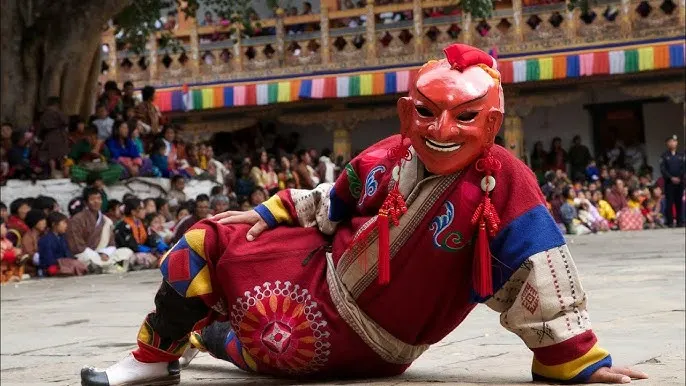
The three-day festival presents a dense sequence of highly choreographed masked dances (cham) performed by monks of the Central Monastic Body and trained laymen. Visitors witness iconic performances such as the Dance of the Lords of the Cremation Grounds (Durdag), which reminds viewers of mortality, and the Dance of the Terrifying Deities (Tungam), designed to subjugate negative forces.
Between monastic dances, traditional Bhutanese folk singers and dancers perform indigenous songs (Boedra and Zhey). The festival is also patrolled by Atsaras—masked clowns holding wooden phalluses who entertain the crowd, interact with tourists, and provide comic relief while maintaining a sacred role in dispelling negative energies.
Key highlights
The Black Hat Dance (Zhana Cham)
A central and highly anticipated feature of the festival schedule. Dancers in broad-brimmed black hats and heavy brocade robes perform an esoteric, powerful ritual dance without masks to pacify malevolent spirits and purify the ground.
Grand Scale & Pageantry
The visual impact of thousands of citizens gathered around Tendrel Thang in elaborate hand-woven ghos and kiras.
Monastic Mask Dances
Precision performances by the monks of Tashichho Dzong.
Visitor information
- Crowd Levels
- Highly crowded. As the largest festival in the capital, seating fills up extremely early in the morning.
- Weather
- Late September brings pleasant, clear autumn days, though mornings and evenings in Thimphu can be crisp.
- Dress Code
- Strict formal attire required—long trousers/skirts, collared shirts, and covered shoulders/legs.
- Etiquette
- Visitors should remain in designated spectator areas and avoid stepping into the central performance area.
- Photography
- Permitted from seating and spectator areas; avoid blocking views or using flash.
What makes this festival special
The Thimphu Tshechu provides a window into how ancient spiritual traditions thrive within the heart of Bhutan's modernizing capital. It is a blend of state grandeur, religious devotion, and large-scale community celebration. For an international traveler, it offers a front-row seat to Bhutan's living heritage, where 17th-century rituals are performed against the imposing backdrop of Tashichho Dzong.
Moments from the festival
Trips that include this festival
 Festival